
From Startup Exit to Speaking Stage: How a Book Becomes Your Best Business Card
You've built something remarkable. You grew it. You scaled it. And if you're reading this, you've probably just exited—sold it, taken it public, merged it, or passed it along. So now what? Here's the uncomfortable truth: all that knowledge, all those hard-won lessons, all the mistakes you learned from and the moves nobody else thought to make? Without a book, it walks out the door with you. We believe that's a tragedy. And we're here to convince you otherwise. A high-quality book isn't a vanity project for exited founders—it's the fastest way to convert the credibility you've already earned into new opportunities: board seats, speaking fees, consulting gigs, and legacy.
The Real ROI of a Founder's Book
Let's be honest: most business books don't sell millions of copies. That's not the point. The actual ROI comes from what happens after someone finishes your book. They call you. They invite you to their podcast. They ask if you'd consider an advisory role at their fund. They remember your framework when they're solving their own problem at 2 a.m.
We've worked with founders who came to us after successful exits. Their exits were impressive—but without a narrative structure, those wins felt like personal stories rather than transferable lessons. A book changes that. It says: I didn't just get lucky. Here's what I learned. Here's what you can use. That distinction transforms a memoir into a thought leadership asset.
One client published a book about scaling manufacturing and immediately started fielding inquiries from other founders building hardware companies. Another focused on the operational playbooks behind their exit, and within six months, they were keynoting three industry conferences. The book didn't make them experts—they already were. The book just gave them credibility signals that the algorithm (human or otherwise) could recognize.

The Production Quality Gap That Kills Credibility
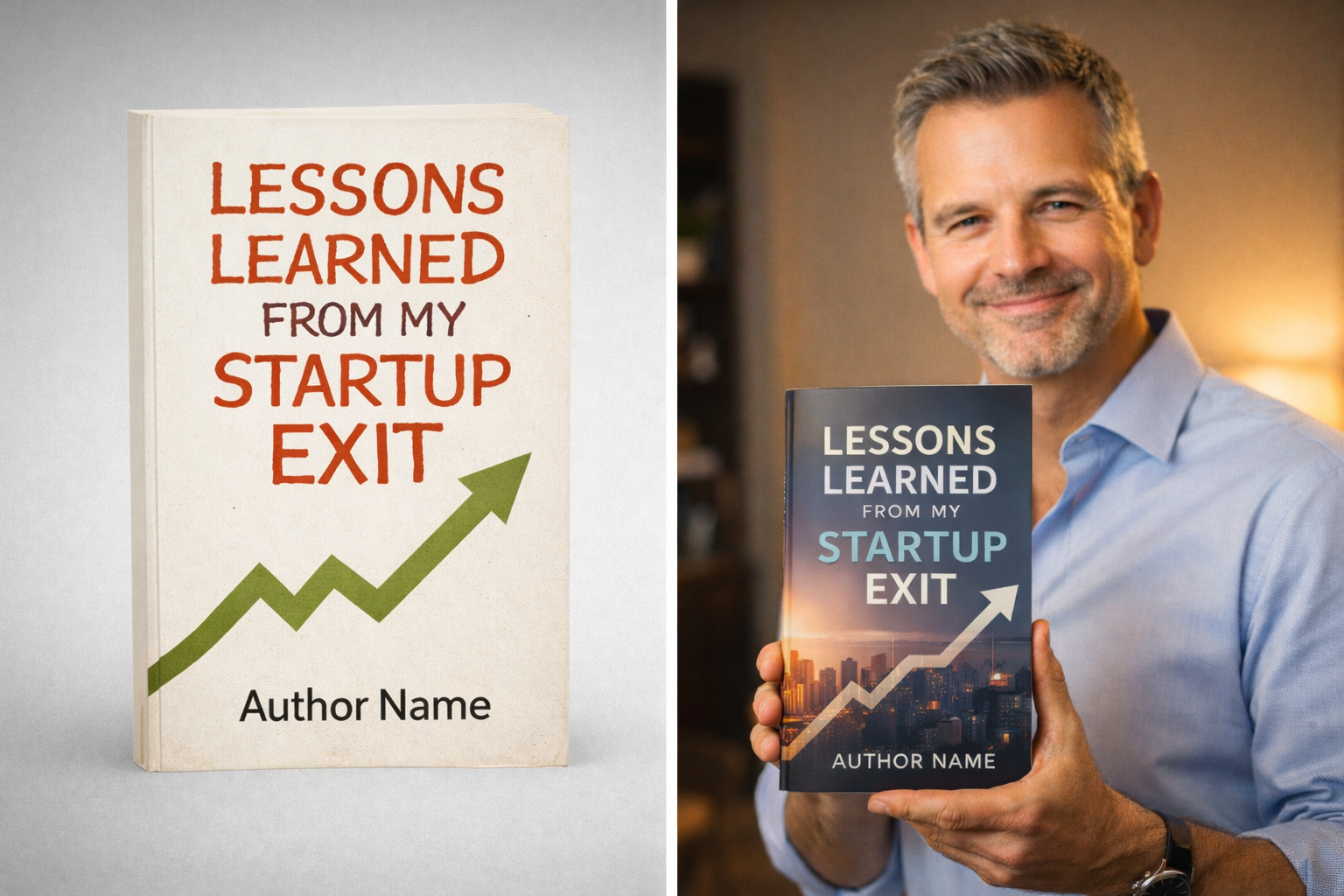
Here's where most DIY self-publishing falls apart. A founder can write a brilliant manuscript, upload it to Amazon KDP, and have a book in the world within weeks. But if the cover looks like it was designed in Canva by someone who'd never seen another book, and the interior is formatted like a Word document from 2003, that book works against your credibility, not for it.
Premium production isn't about ego. It's about signal. Readers—whether they're journalists, conference organizers, or investors—make snap judgments based on physical and visual cues. A thoughtfully designed book with quality paper, tight copyediting, and professional photography (when relevant) tells them you care about the details. That you're not cutting corners. That your thinking is probably worth taking seriously.
We've worked on books with everything from sustainably sourced paper stocks to custom photo curation to full audiobook production. Each choice is deliberate. The author's voice, story, and audience determine the production playbook—not a one-size-fits-all template.
The 4-6 Month Path to Publication (for Busy Founders)
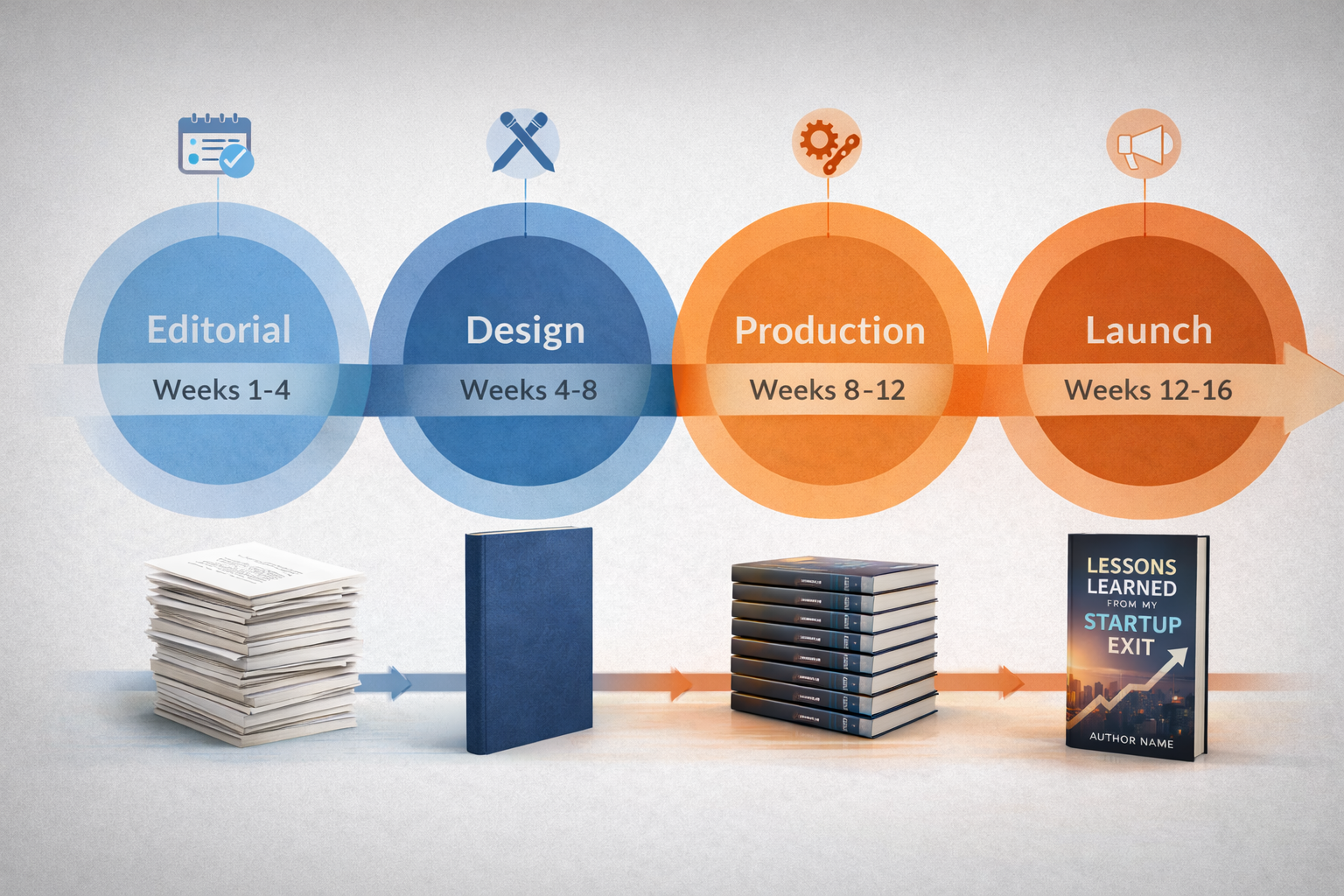
One of the biggest myths is that self-publishing is "fast." It can be—if you're willing to ship something mediocre. Real quality takes time, but not as much as you'd think [Citation].
Developmental editing (shaping your ideas into a coherent structure): 2-4 weeks.
Copyediting and revisions: 2-3 weeks.
Design and layout: 3-6 weeks.
Final proofreading and fact-checking: 2-3 weeks.
Printing and distribution setup: 2-4 weeks.
If you're adding an audiobook, another 4-8 weeks in parallel.
That timeline assumes you've got a solid manuscript to begin with and you're working with professionals who know what they're doing. Rushing any of those phases shows in the final product.
Your Book Is Your Unfair Advantage
In a crowded market, a polished, strategically positioned book does something that social media can't: it shows sustained thinking. It proves you can take an idea from conception through completion. It's a calling card that works for years, not just the 48 hours your last LinkedIn post was trending.
For founders who've built something, exited, or are positioning themselves as an authority in their space, a book isn't optional. It's table stakes. The only question is whether you'll do it right.
